The choice of memory
When does the memorialization of deceased drivers veer into performance—or worst—commercialization?

It was Charles Leclerc who made the biggest splash at the Monaco Grand Prix, diving into the Monte Carlo harbor after his long-awaited home win. But McLaren turned the most heads coming into the weekend.
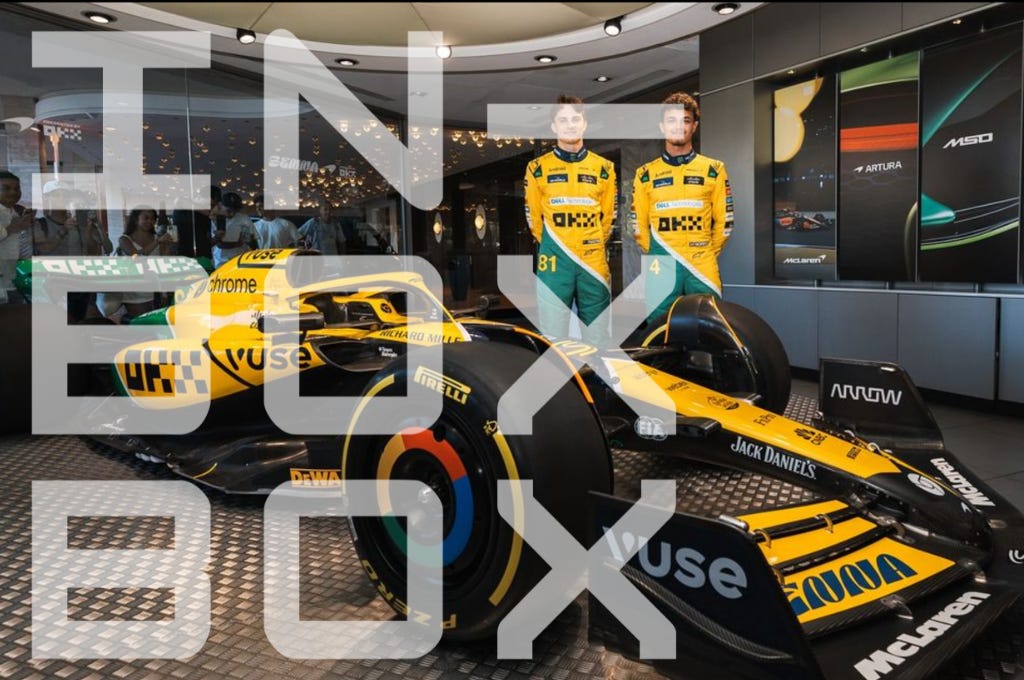
Fresh off the Emilia Romagna Grand Prix, where Formula 1 mourned 30 years since Ayrton Senna’s horrific death at the circuit (then the San Marino Grand Prix), McLaren again paid homage to its three-time world champion and six-time Monaco Grand Prix winner with a weekend-specific livery taking inspiration from Senna’s helmet. Both Lando Norris and Oscar Piastri sported helmets with similar color schemes. The fresh design was a collaboration between Senna Global, the driver’s brand, and global cryptocurrency OKX.
Only the week before in Imola, F1 drivers honored Senna and Roland Ratzenberger, who died the same race weekend as the Brazilian driver. Following the grand prix, Sebastian Vettel completed a demo run in Senna’s 1993 MP4/8, sporting a helmet with both Senna and Ratzenberger’s designs.
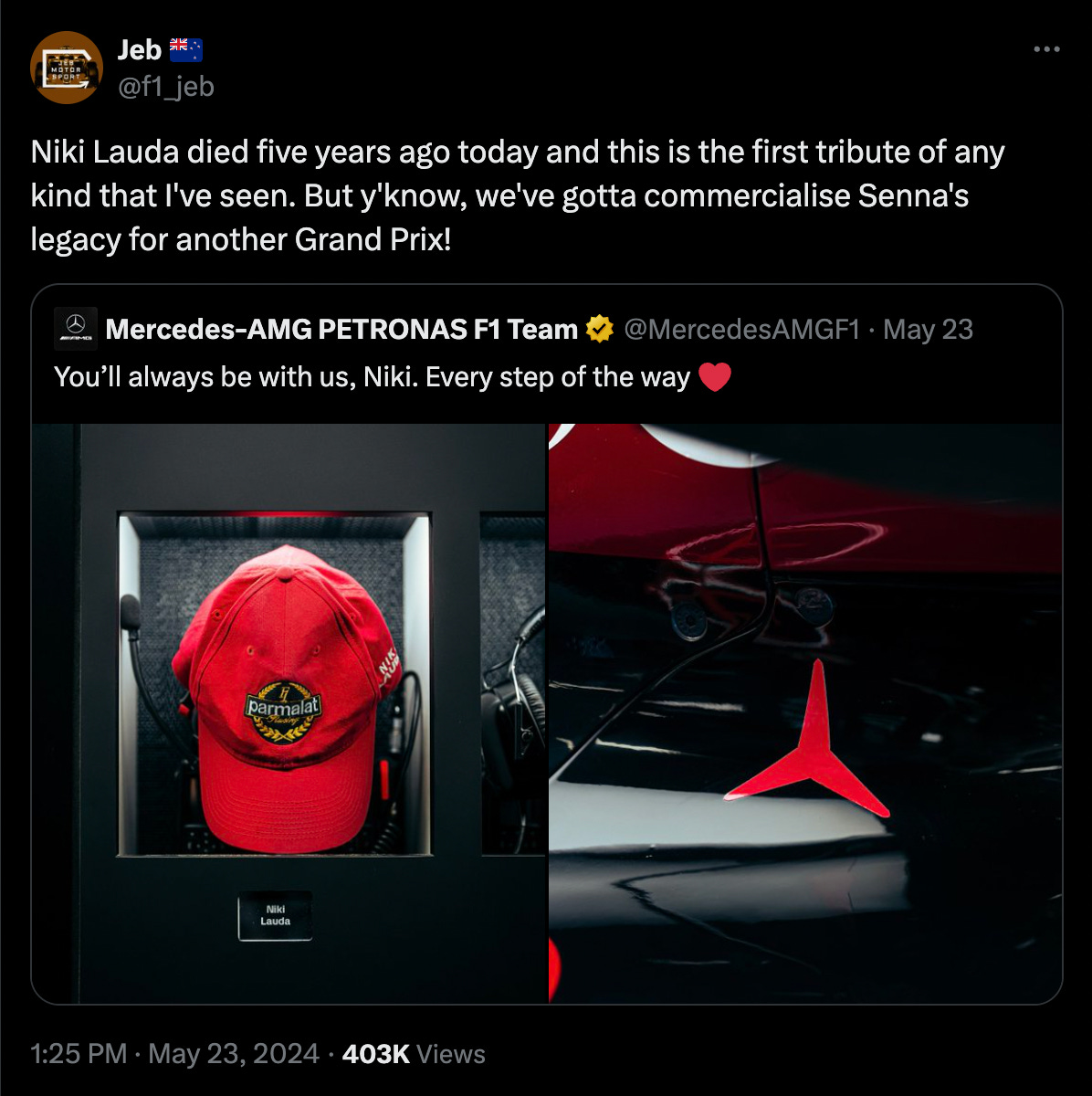
But fans privy to the tributes over the course of the two weeks were not quite sold on the meaning behind them. Some criticized McLaren for milking Senna’s legacy and tragic death, while others noticed that during this year’s Monaco Grand Prix, F1 had seemingly forgotten about the five-year anniversary of the death former McLaren driver and three-time world champion Niki Lauda. Rather than instill pride and awe in its tribune livery, McLaren had instead alienated a portion of its audience.
F1 has a complicated relationship with its fallen drivers. Their deaths are a reminder of the true stakes of the sport—that these racers are indeed athletes and daredevils who put their lives on the line in the name of dream-following. But F1’s spotlight on the deceased and their loved ones also, to some, feel like another way the sport is cashing in.
I think back to Defector writer Kathryn Xu’s piece “What Does It Mean To Mourn In Formula 1?” about how Pierre Gasly continues to honor his late friend Anthoine Hubert after the F2 driver died in an accident at Spa-Francorchamps in 2019. Every year, there are countless photographs published of Gasly laying flowers trackside in Hubert’s memory.
“I wonder, Who is this serving? Maybe the idea that someone's personal grief can become others' public property, so long as that someone is famous, doesn't sit well with me. It is always instinctive to encounter tragedy and to try to make meaning out of it, but if Hubert's death was a catalyst for Gasly to push himself into greatness, that should stay his story and his alone. It feels gauche for spectators to try to coax a full sports story—almost always uplifting, as a requirement of the genre—out of a real person's persevering grief.”
Similarly, there’s nothing wrong with collective grief or memory. Many drivers on the grid cite Senna as their personal hero, and Vettel was visibly emotional at the conclusion of his demo run of Senna’s car. Tributes can bring catharsis, intimacy, and healing to those mourning. But F1’s repeated tributes may have crossed a line from remembrance to deification to commodification and commercialization.
Senna certainly deserves to continue to be honored for his impact on the sport—as do all drivers with their names written in the history books. But maybe our decision on who and how to mourn should not be the fodder of brand partnerships and tabloid photographs.
Lest we really forget Senna’s—and all killed drivers’—continued impact on the sport: After Senna and Ratzenberger’s accidents, F1 had a long look in the mirror at its safety precautions. Sid Watkins, the doctor who treated Senna trackside in a desperate effort to prevent his death, was a champion for this. In the late 1990s, Watkins saw to fruition the modern-day fleet of safety cars. He advocated for better flame-resistant overalls, tighter seatbelts, and additional padding in the car. As a result of his efforts, Watkins was credited for saving the lives of Mika Häkkinen and Rubens Barrichello, as well as saving Martin Brundle’s foot from amputation.
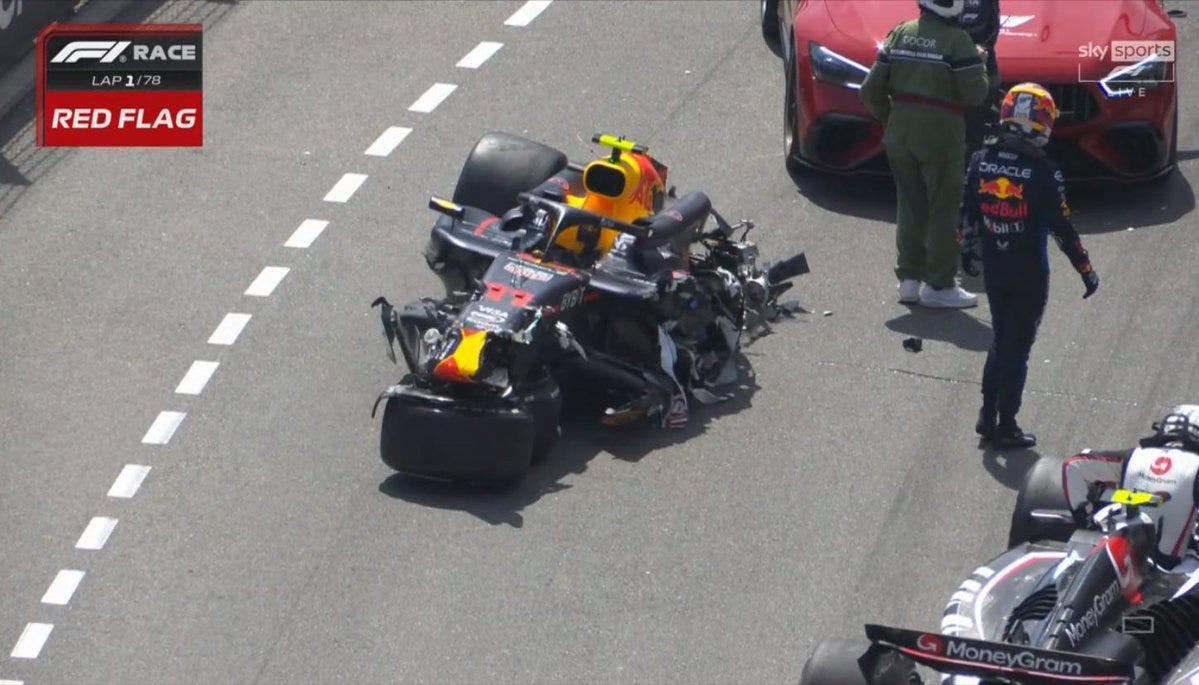
Senna’s true legacy was on full display at the Monaco Grand Prix: Not on a livery or repetitive Instagram grid posts, but in Sergio Perez easily hopping out of his battered Red Bull after slamming hard into the barriers at Turn 2, disposing of three of the car’s tires and rendering its side pods strap medal. In the seconds following the nasty accident, no one even batted an eye.
On-track debris:
Leclerc broke his Monaco curse, but McLaren started a brand new one: three runner-ups in three different racing series.

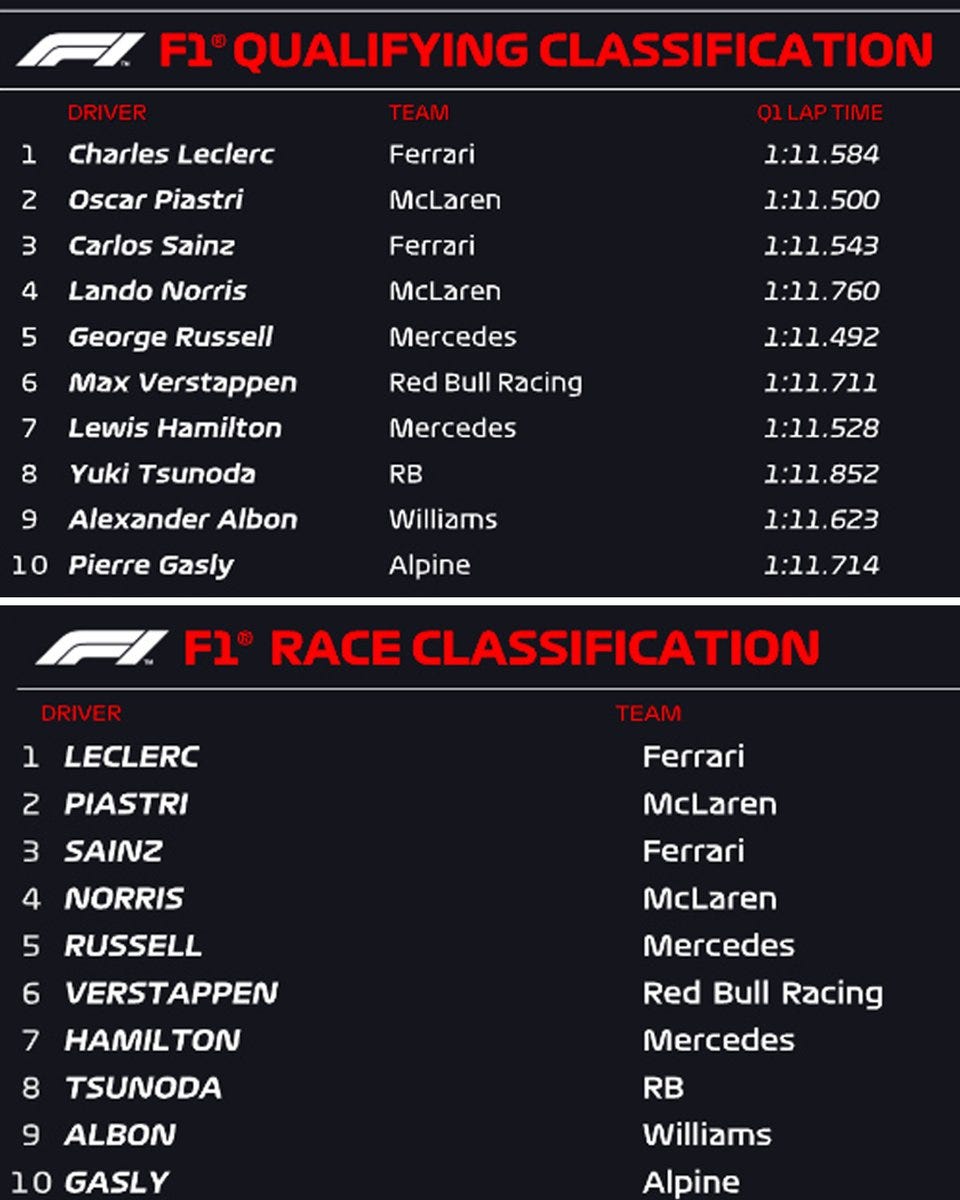
The Monaco Grand Prix was the first race in F1 to have its top 10 grid spots remain unchanged (I’m assuming for a full-length race). I don’t have the energy for or interest in the should-Monaco-stay-on-the-F1-calendar discourse (not this year anyway—but here are my thoughts from my first ever Inboxbox post), but this certainly isn’t a great record to pull the same weekend as the Indy500, which saw a last-lap overtake for the win of the race.